
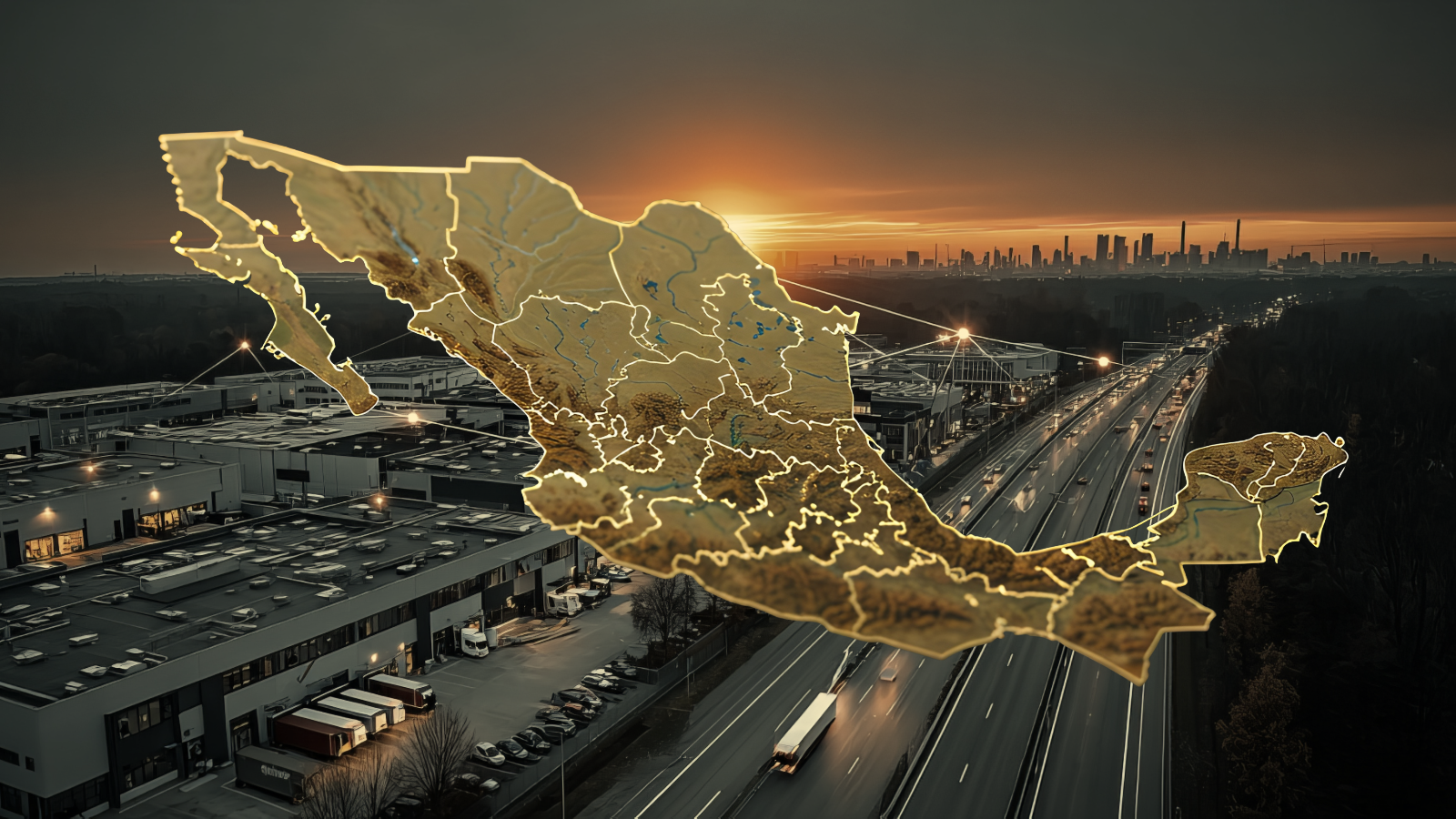
477 industrial parks in Mexico: the concentration map defining where opportunity lies
The Mexican Association of Private Industrial Parks (AMPIP) registers a total of 477 operating industrial parks distributed across 28 federal entities in 2026. That number — the highest in Mexico's industrial real estate industry history — is both a market maturity signal and a map of its most revealing asymmetries. Because not all those parks are uniformly distributed, and the geography of concentration says more about where real opportunity lies in 2026 than any price-per-square-meter analysis. (Source: AMPIP / Proyectos México, 2026)
The concentration of projects in the north and Bajío — which together concentrate the vast majority of the country's industrial inventory and absorption — contrasts notably with regions still lacking sufficient infrastructure to capture the investment wave nearshoring is generating. And that asymmetry is creating two simultaneous phenomena: saturation in the most consolidated corridors, and opportunity in those in maturation process.
The concentration map — and what it reveals
The northeastern corridor — primarily Nuevo León, with Apodaca as its most active submarket — concentrates the country's largest industrial market with 25.8 million sqm of inventory and a 7.3% availability rate at 2Q 2026. Monterrey simultaneously absorbs automotive, metalworking, electronics, and appliance manufacturing projects, giving it the broadest sectoral diversification of any individual corridor in Mexico.
The Bajío — Querétaro, Guanajuato, Aguascalientes — has the greatest sector diversity per square meter: aerospace, automotive, medical devices, pharmaceuticals, semiconductors, and now data centers, all within a 200-kilometer radius corridor. Querétaro specifically has the country's most multi-sectoral corridor — and the one experiencing the most demand pressure in 2026.
The northern border corridor — Juárez, Tijuana, Mexicali, Matamoros — has the closest U.S. proximity and the country's lowest vacancy rates in conventional manufacturing, but also the most severe bottlenecks in energy, water, and border crossing. It is the corridor most directly absorbing first-generation nearshoring — and where infrastructure restrictions are most visible.
The emerging corridors the map still doesn't show well
The most important asymmetry in the 477-park map isn't in what the north and Bajío concentrate — it's in what the south and west-central areas still don't have but are actively building.
The Bienestar Economic Development Poles (PODECOBI) of the Isthmus of Tehuantepec Interoceanic Corridor are Mexico's most ambitious industrial policy bet to decentralize nearshoring. 14 PODECOBI designed to attract industries aligned with regional productive vocations will be established in the Isthmus area of influence. The logic is clear: the Isthmus connects the Pacific with the Gulf in less than 300 kilometers, making it a shorter transit logistics route than the Panama Canal for certain Pacific-to-Gulf of Mexico loads. (Source: Proyectos México, 2026)
The central corridor — Estado de México, Hidalgo, Tlaxcala — is in maturation process for pharmaceutical manufacturing, medical devices, and domestic-market-oriented appliances. It has the country's highest university density for specialized technical talent, and Plan México incentives are beginning to generate concrete installation projects.
Key insightThe immediate investment authorization decree published in June 2026 allows companies to start strategic projects through a single digital process with a maximum 30-business-day resolution. That decree particularly favors corridors with infrastructure already ready — because authorization speed only generates advantage if the park can deliver space within the timelines the authorization makes possible. Corridors with parks under construction or with available lots are those most capturing the decree's benefit. (Source: Proyectos México / DOF, June 2026)
What the 477-park map implies for the location decision
Mexico's industrial park proliferation in 2026 has a practical implication few companies are reading correctly: more parks doesn't mean more equally good options — it means more options with infrastructure quality, ecosystem, and resource availability differences that are harder to evaluate than before.
When there were 200 industrial parks in Mexico, the question was relatively simple: "which state do I establish in?" With 477 parks across 28 states, the right question is: "among all the parks meeting my minimum location requirement, which ones have the energy-water-transmission triangle resolved, the right supplier ecosystem for my sector, and the specialized infrastructure my operation requires from day one?"
That question has a different answer depending on the sector and operation size — and finding the right answer before signing is significantly more valuable than negotiating the last cent of price per square meter.
At Miller Parks we develop in corridors with that infrastructure resolved from design: Salinas Victoria and Apodaca in Nuevo León, Toluca, Tepeji del Río, and Naucalpan in central Mexico. Contact us — the conversation about the right corridor starts before there are 478 parks in the market.
Want to understand how nearshoring concentration in certain corridors is creating demand pressure in adjacent ones? Also read: Nearshoring 2.0: energy, water, and transmission — not price — define viability
Sources: AMPIP (ampip.org.mx) · Proyectos México (proyectosmexico.gob.mx) · Mexico Business News (mexicobusiness.news) · CBRE México (cbre.com.mx) · Colliers México (colliers.com/mx)
EL ANÁLISIS INDUSTRIAL DIRECTO EN TU CORREO.
Cada semana publicamos noticias, datos y perspectivas del mercado industrial en México.