
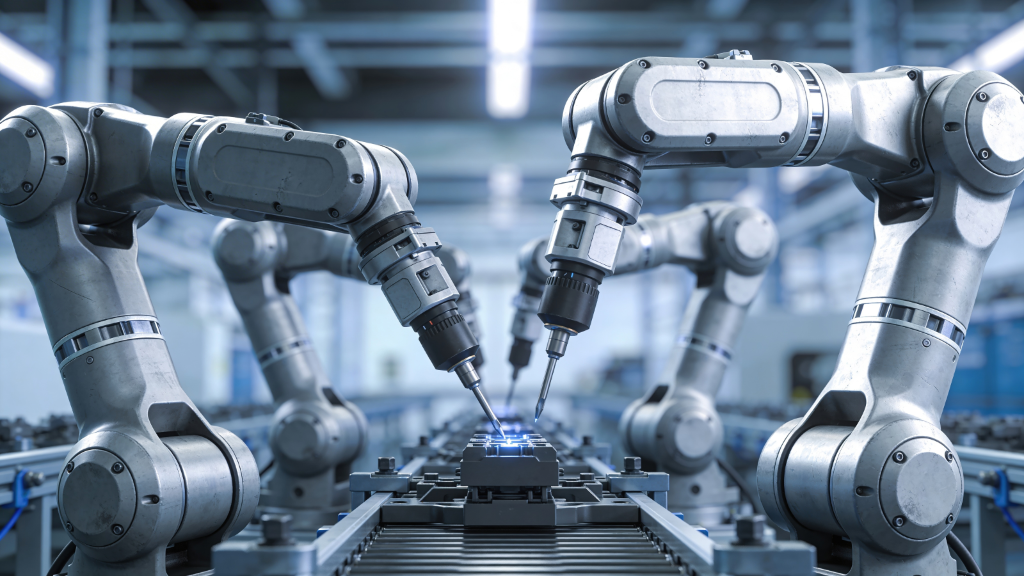
AI on Mexico's production lines: no longer the future, it's today's competitive advantage
This week, Advantech — one of the leading global industrial technology providers — presents in Mexico a session on how artificial intelligence is already optimizing production lines today, not in the future. The event reflects something data already confirms: 96% of organizations report operational and efficiency improvements after adopting AI technologies in manufacturing, according to KPMG's smart manufacturing report. (Source: Mexico Industry / KPMG, August 2026)
What is relevant for the industrial market is not the percentage — it is the "already." AI in manufacturing moved from being a technology under evaluation to an active operational differentiator in the most advanced plants operating in Mexico. And that transition has direct implications for what an industrial facility must be able to offer.
How AI is changing manufacturing in Mexico right now
Artificial intelligence in manufacturing is not a single system — it is a layer of capabilities applied over existing data infrastructure. In Mexico's most advanced plants, those capabilities are already producing concrete results in three areas with direct impact on operational competitiveness.
The first is real-time quality management. When AI is combined with advanced metrology — precision sensors integrated into the production line measuring dimensions, tolerances, and material properties in each piece — measurement data allows anticipating deviations before they occur. Instead of detecting a defective batch after producing it, the system adjusts process parameters in real time to maintain production within specification. For industries with tight tolerances — aerospace, medical devices, precision electronics — that capability is not optional: it is a competitiveness condition. (Source: KPMG / Manufactura LATAM, 2026)
The second is predictive maintenance. AI algorithms analyzing vibration, temperature, electrical consumption, and equipment usage pattern data can predict failures hours or days in advance. That converts maintenance from reactive to preventive — reducing unplanned stoppages, extending equipment useful life, and eliminating the cost of emergency stoppages that are three to five times more expensive than planned maintenance.
The third is energy consumption optimization. AI systems monitoring each machine's electrical consumption in real time and correlating it with electricity market prices, production demand, and park energy source capacities can reduce a manufacturing operation's energy cost between 15% and 25% without changing a single production process. For operations in corridors with variable electricity rates, that capability has a direct impact on operating margin.
Key insightAdvanced manufacturing in Mexico in 2026 is accelerating simultaneous adoption of three mutually reinforcing technologies: complete plant digitalization, intelligent automation, and advanced metrology integrated with AI. The sectors adopting this combination fastest are exactly those receiving the most investment: next-generation automotive, aerospace, medical devices, and precision electronics. Querétaro's Aerocluster, with 60 companies and 15,000 jobs, is the ecosystem where that combination is most mature in Mexico. (Source: Manufactura LATAM / Cluster Industrial / KPMG, 2026)
What AI demands from facility infrastructure
Here is the point connecting directly to the real estate decision: AI in manufacturing doesn't work without data, and data doesn't flow without infrastructure. A facility not designed to support the systems industrial AI requires will limit its tenant's capacity to implement these technologies — and that limitation has a cost appearing in no lease contract but felt in the P&L from year one.
IIoT sensors feeding AI quality and predictive maintenance systems need low-latency, high-availability connectivity from every point on the production line. That requires the facility to have fiber optic conduits distributed throughout the plant from original construction, not as later retrofit. Energy optimization systems need real-time access to each machine's consumption data and park production data — requiring integration between the park's energy management system and the tenant's plant systems.
Predictive maintenance systems processing data from hundreds of sensors in milliseconds need edge computing capacity available within the park, not dependent exclusively on the cloud. And real energy redundancy ensures that when there's a grid event, AI systems don't lose the data thread they need to keep their models calibrated.
Why corridor choice determines adoption speed
Industrial AI doesn't implement the same way in all Mexico corridors. Corridors with high density of companies that already implemented these technologies — and therefore have local technical talent with industrial AI experience — allow a significantly faster adoption curve than corridors where the company has to build that knowledge from scratch.
The Querétaro-Bajío corridor, with its mature aerospace ecosystem and the Aerocluster's 60 companies, has the highest concentration of talent experienced in advanced metrology, IIoT systems, and AI applied in precision manufacturing. Nuevo León — with its automotive and electronics manufacturing density — has the most developed industrial technology services and supplier ecosystem in the north. Central Mexico corridors — Toluca, Estado de México, Hidalgo — have access to universities with the highest density of programs in data engineering, applied computer science, and mechatronics.
AI in manufacturing is not the future of nearshoring in Mexico — it is the present of operations that will remain competitive in the peak cycle Banco de México projects through 2030. Those that don't adopt these technologies will fall below the standard the market is already establishing.
Want to understand how traceability connects with AI to create the operational advantage of advanced nearshoring? Also read: Nearshoring in operation: producing in Mexico is no longer enough, you must operate as a system
Sources: Mexico Industry / Advantech (mexicoindustry.com) · KPMG México (kpmg.com/mx) · Manufactura LATAM (manufactura-latam.com) · Cluster Industrial (clusterindustrial.com.mx) · T21 (t21.com.mx)
EL ANÁLISIS INDUSTRIAL DIRECTO EN TU CORREO.
Cada semana publicamos noticias, datos y perspectivas del mercado industrial en México.