
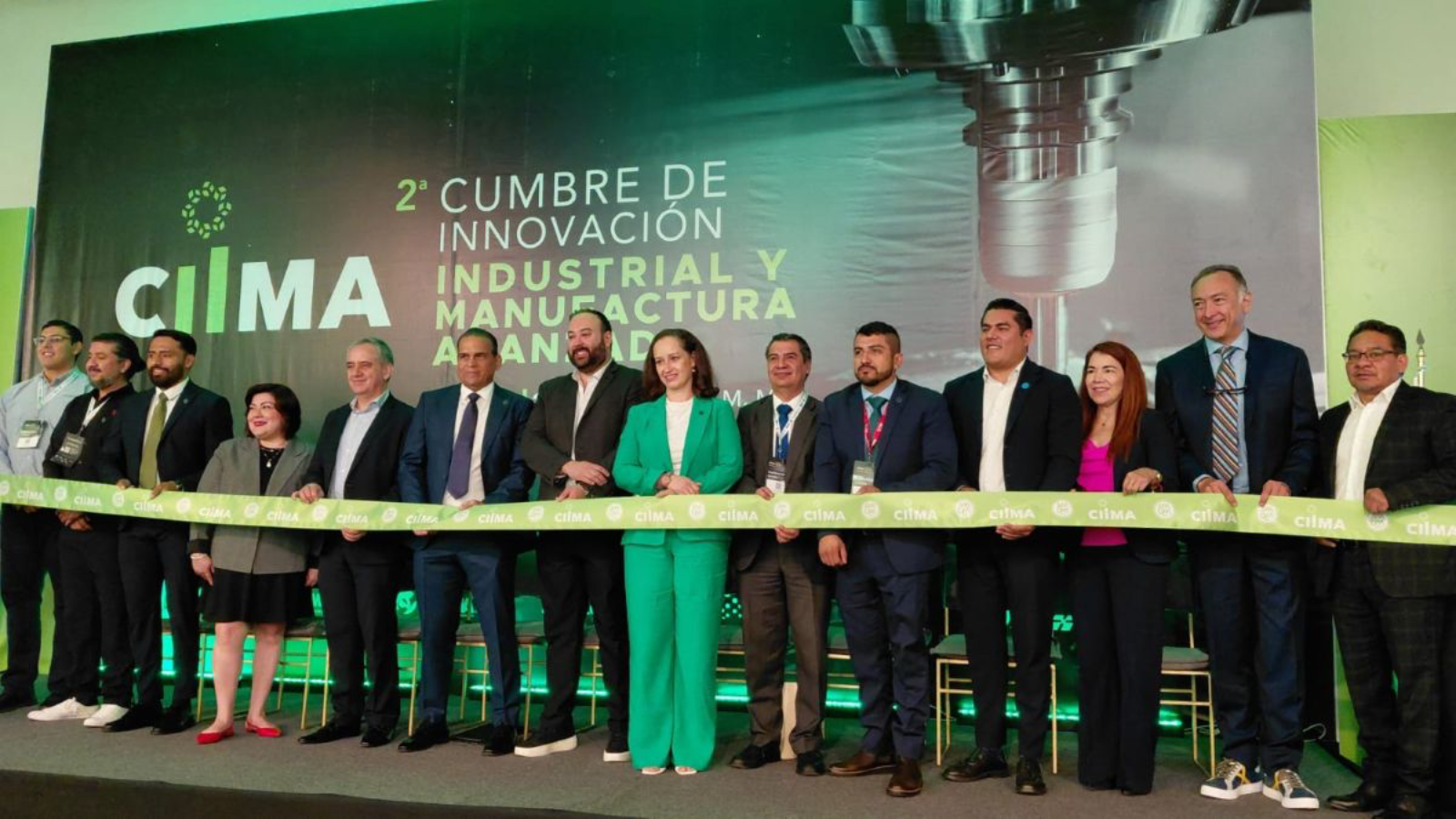
CIIMA 2026: Monterrey Hosts Advanced Manufacturing Leaders and Defines the Next Industrial Cycle
Monterrey doesn’t just manufacture; it also thinks about how it will manufacture the future. The International Congress of Industry and Advanced Manufacturing (CIIMA) 2026 brought the region’s top industrial transformation exponents together, with a central message that resonated across all presentations: competitiveness is no longer individual. “Today companies no longer compete, ecosystems do,” stated Ana Vigil, representative of the Mexican Association of Manufacturing Directors (AMDM), in a phrase that summarized the spirit of the congress.
The technological landscape: three pillars of advanced manufacturing
The technical content of CIIMA 2026 revolved around three technologies that are redefining global manufacturing and that, at varying degrees of maturity, are already present in Mexico’s industrial parks.
Siemens presented advances in digital twins applied to manufacturing. A digital twin is a virtual replica of a process, machine, or complete facility that allows simulating, optimizing, and predicting behaviors before they occur in the physical world. In the context of manufacturing plants, this technology reduces setup times, minimizes material waste in physical tests, and allows optimizing operational performance in real time. For industrial facility developers, the implication is direct: buildings housing advanced manufacturing require connectivity infrastructure — fiber, low-latency networks, uninterruptible power systems — that Class A standards must incorporate.
Key data: At CIIMA 2026, Siemens presented digital twin applications for manufacturing, Universal Robots showcased collaborative robotics cases on assembly lines, and Autodesk demonstrated digital manufacturing platforms. The congress was held in Monterrey with the presence of the country’s leading industrial leaders (Vanguardia Industrial, May 2026).
Collaborative robotics: the next step in automation
Universal Robots presented its latest collaborative robotics cases — cobots — on assembly lines at CIIMA 2026. Unlike traditional industrial robotics, which operates in areas segregated from human personnel, cobots work alongside operators without the need for safety fences, adapting to tasks that require precision but change frequently. For nearshoring manufacturing plants — which often produce multiple product lines for different markets — this flexibility is a critical asset.
Collaborative robotics is democratizing automation in Mexico: it is no longer exclusive to large manufacturers with multimillion-dollar investments, but accessible to mid-sized companies seeking efficiency without sacrificing adaptability. This trend has implications for industrial facility design: clear heights, floor load capacity, electrical service distribution, and building management systems must be anticipated from the design stage.
Digital manufacturing: connecting design to production
Autodesk completed CIIMA 2026’s technological triangle with its digital manufacturing platforms, which connect product design with the manufacturing process in a continuous information flow. In an environment where product customization and delivery time reduction are competitive imperatives, the ability to translate a design directly into machine instructions — without information losses or manual rework — is an advantage that translates into cost and speed.
Ecosystems, not companies: the new unit of competition
Ana Vigil’s phrase — “Today companies no longer compete, ecosystems do” — was the most cited at the congress because it precisely describes the reality of the contemporary industrial market. A company operating in isolation, with limited local suppliers, without access to specialized technical services and without connectivity to the global chain, cannot be competitive regardless of the quality of its machinery. Competitiveness emerges from the combination of company, suppliers, infrastructure, talent, and support services surrounding each installation.
Key data: “Today companies no longer compete, ecosystems do.” — Ana Vigil, AMDM, CIIMA 2026. This perspective redefines the role of the industrial park: it is no longer just a container of facilities, but the environment that activates or limits the competitiveness of those who operate within it.
For Class A facility developers, this vision redefines the product. An industrial park is not just land, construction, and basic services. It is the ecosystem the tenant adopts when signing a contract. Supplier density, shared infrastructure quality, available support services, and connectivity with the global chain are park attributes that determine the competitiveness of every company that inhabits it. CIIMA 2026 made clear that Industry 4.0 is not a destination; it is the minimum operating standard in today’s global manufacturing.
Sources: Vanguardia Industrial (vanguardiaindustrial.com.mx)
EL ANÁLISIS INDUSTRIAL DIRECTO EN TU CORREO.
Cada semana publicamos noticias, datos y perspectivas del mercado industrial en México.