
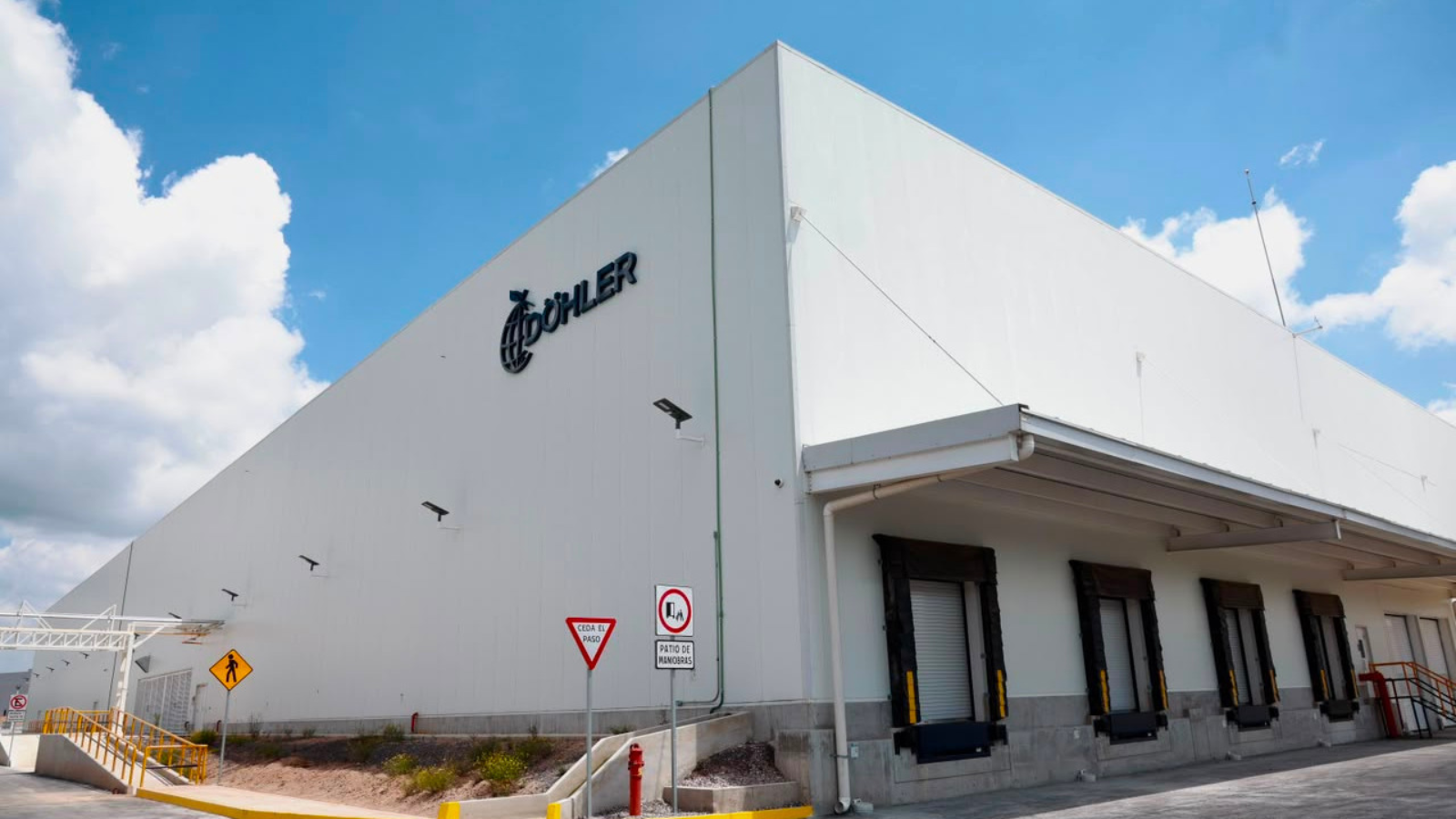
Döhler opens in Estado de México: central Mexico's densest food corridor takes shape
There is a story in central Mexico's industrial market that nearshoring reports rarely tell with sufficient depth — and that Döhler's July 2026 announcement brings back to the foreground: Estado de México is the country's densest food and beverage manufacturing corridor, and it is attracting quality industrial investment with no connection to automotive, aerospace, or semiconductors that dominate nearshoring headlines. German company Döhler — one of the world's largest manufacturers of natural ingredients, flavors, extracts, and ingredient systems for the food and beverage industry — launched its new plant in Soyaniquilpan, Estado de México, with an investment exceeding 1.2 billion pesos. (Source: Real Estate Market / Mexico Industry, July 2026)
Döhler didn't arrive in Estado de México by accident. The state's Economic Development Secretary, Laura González Hernández, explains it precisely: "The food and beverage industry represents one of the fastest-growing manufacturing sectors in the state." That statement is backed by concrete data: Estado de México concentrates over 31,000 economic units dedicated to food manufacturing — the densest food manufacturing ecosystem of any federal entity in the country. Those 31,000 units employ over 146,000 people in the sector, with a technical talent density in food processing, food quality control, and food safety certifications that few Mexican regions can match. (Source: Real Estate Market, July 2026)
Why Döhler in Soyaniquilpan reveals something structural about the central corridor
Döhler's investment profile — natural ingredients, flavors, and ingredient systems manufacturing for the export food and beverage industry — has industrial infrastructure requirements very different from the automotive or electronics manufacturing conventional nearshoring seeks. It needs strict environmental control to preserve natural ingredient integrity, food material handling systems meeting FDA and FSSC 22000 standards, cold chain connectivity for certain temperature-sensitive ingredients, and logistics access toward the consumer markets where its clients — major food and beverage companies — have their production plants.
Estado de México has that combination: it is in the center of the country's densest distribution network, with direct access to Mexico's largest market and primary corridors toward south and west. The Mexico-Pachuca highway, the Arco Norte, and Mexico City connectivity convert Soyaniquilpan into a point from which Döhler can supply clients throughout the country and in Central America in delivery times that no northern industrial corridor can match for that market.
Between September 2023 and May 2026, food sector companies in Estado de México invested 8,172 million pesos in domestic investment and over 2,000 million pesos in foreign direct investment — figures confirming that food manufacturing investment in the corridor is not an isolated phenomenon but a structural pattern. (Source: Real Estate Market, July 2026)
The corridor generating the most employment in Mexico — and what that says about its ecosystem
Estado de México accumulated 281,404 new jobs between September 2023 and June 2026 — the highest employment generation of any federal entity in the country during that period, according to state government data. That figure is not abstract statistics — it is the most direct evidence that the state's industrial economy is absorbing investment and converting it into employment at a pace no other state has matched.
For the industrial facility market, the 281,404 new jobs data point has a direct implication: that level of employment absorption means there is demand for industrial space, local suppliers, industrial services, and support infrastructure at a scale justifying new park construction and expansion of existing ones. The Estado de México corridor is not a niche market — it is the country's third state in FDI capture according to Q1 2025 Secretaría de Economía data, with 9% of the total. (Source: Secretaría de Economía / Real Estate Market, 2026)
Key insightDöhler operates globally with a network of 74 plants in over 150 countries, and its selection of Estado de México for its first large-scale plant in Mexico — with investment exceeding 1.2 billion pesos — is the most concrete signal that the central corridor has the industrial ecosystem for advanced ingredient and food specialty manufacturing that the Latin American food and beverage market will demand over the next ten years. Mexico's food and beverage industry grew consistently even during periods of general economic contraction — it has more stable demand than automotive, is less sensitive to USMCA cycles, and has an enormous domestic market consuming what it produces, in addition to exporting. For the Estado de México corridor, that combination is exactly what produces the most predictable industrial facility demand in the market. (Source: Real Estate Market / Estado de México Government, 2026)
What the Döhler model implies for the corridor and its parks
Döhler's Soyaniquilpan plant has an infrastructure requirements profile that Estado de México corridor industrial parks are learning to satisfy: environmental control for natural ingredient manufacturing, redundant energy systems for temperature-controlled processes, load handling capacity for large volumes of natural raw materials, and logistics connectivity toward the state's distribution network. Those requirements are not the same as an automotive or electronics facility — more specific in some variables (temperature control, organic material handling) and less demanding in others (precision dimensional tolerances, clean rooms).
For industrial park developers in Estado de México, Döhler's move is the signal that there is a demand segment for facilities with advanced food manufacturing specifications that the corridor is beginning to develop systematically. Parks anticipating that demand with correct specifications — environmental control, wastewater systems for food processing, natural raw material storage — will be in the right position when the second wave of specialized food manufacturing investment arrives in the corridor.
Want to understand how central Mexico's corridor is diversifying its industrial base beyond automotive? Also read: SOPREMA invests $300M in San Miguel: Guanajuato diversifies beyond automotive
Sources: Real Estate Market (realestatemarket.com.mx) · Mexico Industry (mexicoindustry.com) · Estado de México Government (edomex.gob.mx) · Secretaría de Economía (economia.gob.mx) · Cluster Industrial (clusterindustrial.com.mx)
EL ANÁLISIS INDUSTRIAL DIRECTO EN TU CORREO.
Cada semana publicamos noticias, datos y perspectivas del mercado industrial en México.