
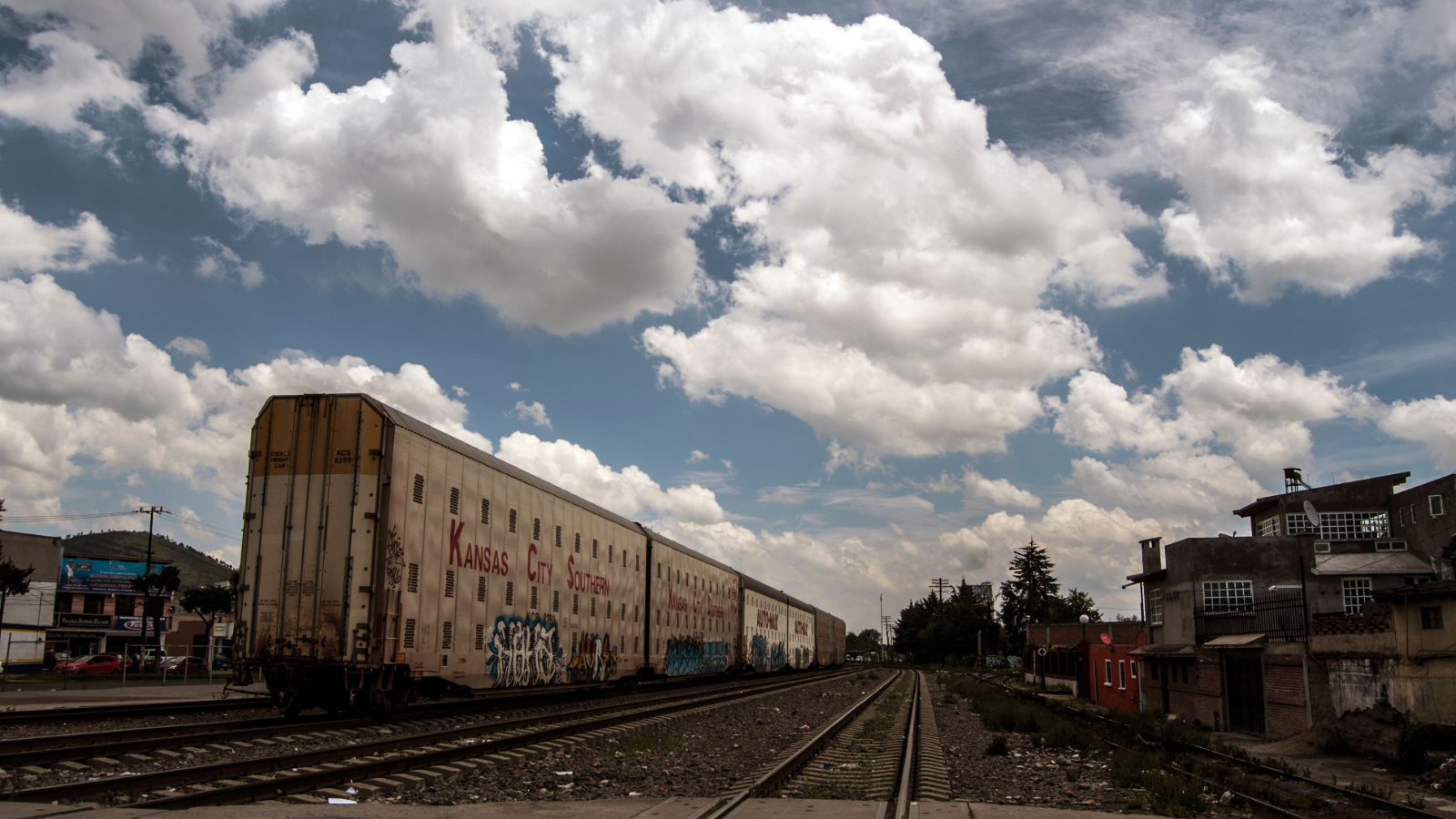
Rail costs 38% less but moves only 26% of cargo: nearshoring's railway paradox
There is a number in Mexico's logistics system summarizing the central nearshoring logistics challenge more precisely than any other: freight rail in Mexico costs 38% less per ton than road transport, but moves barely 26% of the country's cargo. That gap — between rail's cost advantage and its minority share of total volume — is the most important logistics paradox advanced nearshoring must resolve in the next five years. (Source: Transporte.mx / Bonanza Logistics, 2026)
Mexico's cargo transport and logistics market will grow 5.38% in 2026 according to Mordor Intelligence projections — growth reflecting nearshoring's dynamism but being absorbed almost entirely by road transport, which today moves the remaining 74% of national cargo. That road transport concentration is not cultural preference or inexplicable inertia: it results from Mexico's freight rail infrastructure, originally designed for large raw material volumes on long-distance routes, not being optimized for the logistics needs advanced nearshoring manufacturing requires.
Why rail doesn't capture nearshoring cargo despite its cost advantage
Advanced nearshoring manufacturing has logistics requirements conventional freight rail meets with difficulty in the current Mexican context.
The first is delivery window. An automotive manufacturing JIT model needing a component arriving at the assembly line in a four-hour window cannot tolerate transit time variability rail generates when sharing tracks with long-distance heavy cargo. Road transport can commit to hour-range delivery windows — rail, in its current configuration, rarely can.
The second is lot profile. Rail is more efficient at higher volume per trip — designed for full trainloads of raw materials or bulk products. Nearshoring manufacturing produces high-value, low-physical-volume component lots, shipped at high frequency in volumes not justifying a full car. That lot fragmentation favors road transport, which can make partial shipments with greater flexibility.
The third is last-mile connectivity. Rail requires both origin and destination points to be connected to the rail network — and in Mexico, most industrial parks don't have direct rail connection. The road-rail-road transshipment cost most industrial routes require reduces the 38% cost differential to a much smaller percentage in the total equation.
What the PPEF 2027 changes in this equation
The 2027 Economic Package, presented September 8, assigns the largest railway allocation in Mexico's recent history: 41,985 MDP for the Saltillo-Nuevo Laredo Train, 24,025 MDP for the Querétaro-Saltillo Train, 25,000 MDP for the Isthmus of Tehuantepec, among others. Those investments won't resolve the railway paradox overnight — but they will change the equation for industrial corridors directly on those routes.
The Saltillo-Nuevo Laredo Train, connecting Coahuila's automotive corridor with Mexico's highest-volume border crossing, has the potential to create the first northeastern advanced manufacturing railway flow competitive with road transport in total cost — not just cost per ton, but total cost including time, flexibility, and delivery reliability.
Key insightMexican freight railways lead North American growth in transported volume according to Info-Transportes.com.mx — but that growth is concentrated in raw materials, agricultural products, and import/export containers, not in the high-value component manufacturing advanced nearshoring generates. The gap between the 38% cost advantage and the 26% market share is exactly the opportunity space PPEF 2027's new railway projects are designed to begin closing — but that will take five to ten years to fully materialize. For companies making location decisions today, rail is a near-future variable in corridors PPEF 2027 is prioritizing, and a distant-future variable elsewhere. (Source: Transporte.mx / Info-Transportes.com.mx / Bonanza Logistics, 2026)
Want to understand how PPEF 2027's railway investment transforms logistics in northern and Bajío industrial corridors? Also read: The PPEF 2027 railway map: the industrial corridors connecting toward 2030
Sources: Transporte.mx (transporte.mx) · Info-Transportes (info-transportes.com.mx) · Bonanza Logistics (bonanzalogistics.com.mx) · TyT Magazine (tyt.com.mx) · Hound Express (hound-express.com)
EL ANÁLISIS INDUSTRIAL DIRECTO EN TU CORREO.
Cada semana publicamos noticias, datos y perspectivas del mercado industrial en México.