
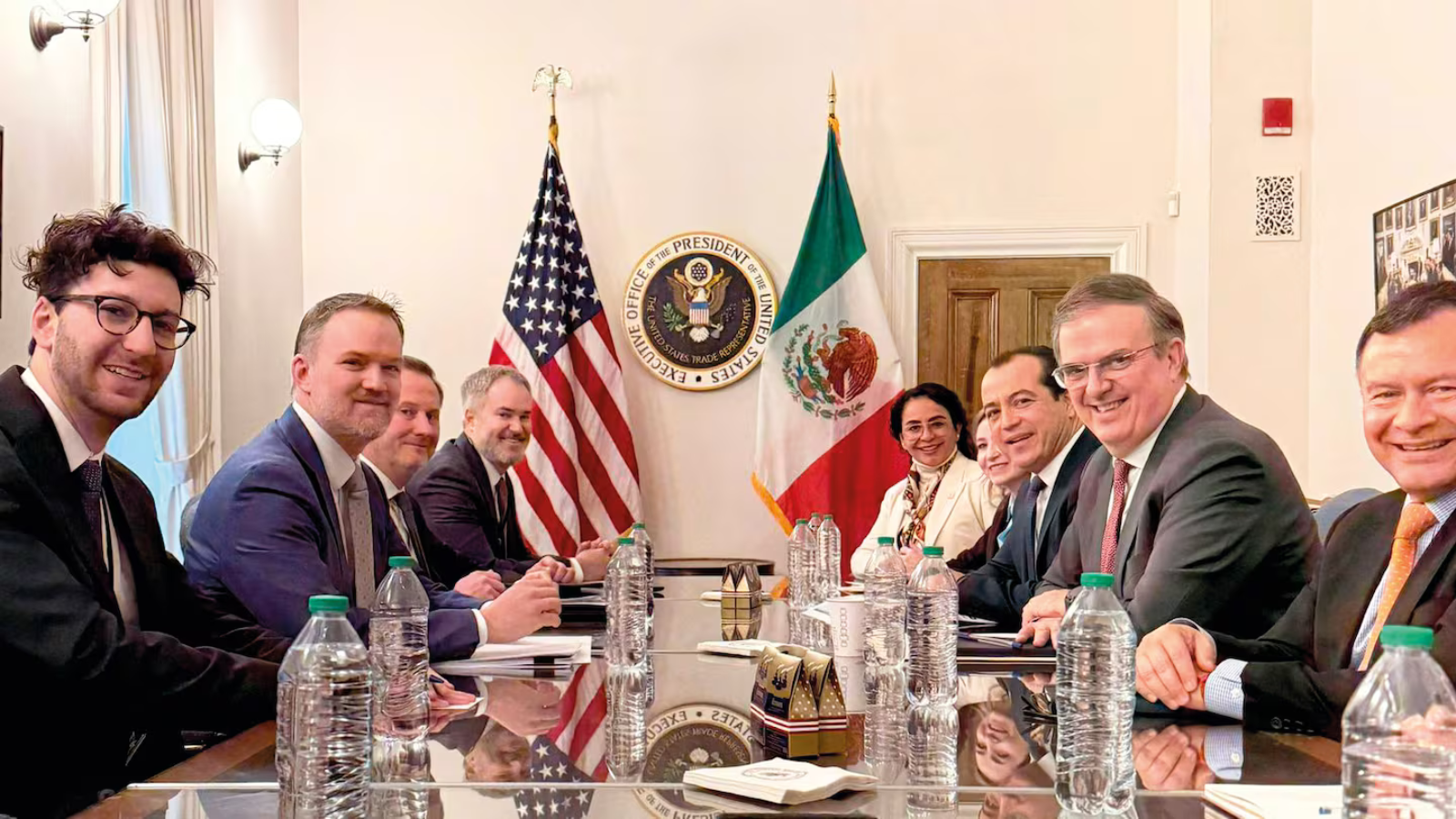
USMCA postponed to Sep 28-29: Trump adds topics and the northern corridor faces its greatest test
The fourth round of bilateral negotiations between Mexico and the United States on USMCA review, scheduled for September 21, was postponed to September 28 and 29 in Washington — and the postponement was not the week's only twist. On Wednesday the 17th, President Donald Trump held a call with President Claudia Sheinbaum that, according to sources cited by El Financiero, generated "a bit of noise" because Trump added new topics to the negotiation that both countries' technical teams had not previously defined. Among those topics: automotive rules of origin and the reduction of Chinese content in artificial intelligence equipment Mexico exports to the United States. (Source: El Financiero, September 2026)
To understand that twist's weight, it is necessary to contextualize the state of negotiations. On July 1, 2026, the U.S. did not renew the USMCA in its current form and opted for annual reviews while the treaty remains in force for ten years. Since then, Mexico and the U.S. have held four bilateral rounds — the first in May, second in June, third in July in Mexico City (agreements on steel, aluminum, value chains, and Asian import substitution), and the fourth now postponed to September 28-29. Canada, meanwhile, broke negotiations with Washington approximately ten days ago, leading to a new U.S. tariff on Canadian imports generating additional pressures in northern U.S. border states. (Source: Bloomberg Línea / El Financiero, 2026)
What Trump's new topics mean for automotive corridors
The addition of automotive rules of origin as a new Trump-Sheinbaum agenda item has a direct implication for northeastern Mexico's industrial corridors — and it is an implication that conventional nearshoring analysis tends to read backwards.
The wrong reading is: "stricter rules of origin = more uncertainty = less investment in the automotive corridor." The correct reading is exactly the opposite: stricter USMCA rules of origin mean vehicles sold in the U.S. must have a higher percentage of North America-produced content — implying more component manufacturing in Mexico and the U.S., not less. For the Coahuila-Nuevo León corridor, concentrating the highest density of Tier 1 and Tier 2 automotive suppliers in northern Mexico, more demanding rules of origin are a demand lever, not a brake.
The Chinese content restriction in AI equipment exported from Mexico has different but equally relevant logic for the industrial map. Mexico is substituting Chinese imports of electronic components and technology equipment — and if USMCA establishes that AI equipment exported from Mexico cannot contain a certain percentage of Chinese components, that creates direct demand for non-Chinese electronic component manufacturing in Mexico. The Bajío-Jalisco corridor, with QSM Semiconductores in Querétaro and Guadalajara's electronics ecosystem, has the most direct technical position to meet that demand. (Source: El Financiero, September 2026)
The Canada collapse and what changes for Mexico
The collapse of U.S.-Canada negotiations, leading to a new U.S. tariff on Canadian products, has two direct consequences for Mexico in the September 28-29 round.
The first is that USTR arrives at that round with domestic political pressure to show concrete results — not just "general progress" as in the first five rounds. Greer needs to announce specific agreements with Mexico he can present as specific victories before Trump. That means Mexico has more negotiating capacity than the narrative of weak peso and low GDP suggests — USTR needs the agreement as much or more than Mexico needs it.
The second is that the new Canadian tariff is generating supply shortage pressures in northern U.S. border states that make Mexican products — tariff-free while USMCA remains in force — immediately more competitive in those markets. For Coahuila-NL corridor plants exporting to Texas, Michigan, Ohio, and Indiana, the competitive differential against tariffed Canadian products is a market window that established companies capture and those waiting don't.
Key insightAccording to sources cited by El Financiero and Bloomberg Línea, Mexico and U.S. negotiating teams are "close to reaching a bilateral agreement" on the main disputed issues before 2026 ends. Ebrard has declared Mexico's intention to close the first annual review before year-end. If that calendar holds, the next round in November in Mexico — where Greer would meet directly with Sheinbaum on non-tariff barriers — and December's in Washington to "close the year's agreements" suggest the market could have a resolution to the USMCA's first annual review before Q1 2027. For companies that signed contracts in northeastern corridors in 2026, that resolution will confirm their decision — not put it at risk. For those that waited for the USMCA to resolve before signing, 2027 could be the year they find the space they wanted is no longer available under 2026 conditions. (Source: El Financiero / Bloomberg Línea, September 2026)
Why the northeastern corridor maintains its strategic position regardless of outcome
For the Apodaca-Salinas Victoria and Saltillo-Ramos Arizpe corridors, USMCA negotiation is a relevant context — but not the variable determining their long-term automotive investment attractiveness. What determines that attractiveness is the already-installed industrial ecosystem: over 20 million square meters of Class A industrial space in the northeast, the highest concentration of Tier 1 automotive suppliers in northern Mexico, the country's most active e-mobility hub with 13 EV projects in Nuevo León in H1 2026, and the border connectivity the $200M Colombia-Laredo bridge is expanding toward 2030.
No specific result from the September 28-29 round changes those structural variables. What can change is the speed with which companies in evaluation processes make the signing decision — and in that sense, a positive signal from the round can be the catalyst activating in weeks projects that have been in evaluation for months.
Want to understand how the current state of USMCA negotiation affects industrial location decisions in the northeastern corridor? Also read: $200M Colombia-Laredo Bridge: Nuevo León and Texas double border capacity
Sources: El Financiero (elfinanciero.com.mx) · Bloomberg Línea (bloomberglinea.com) · Infobae México (infobae.com/mexico) · Mundi.io (mundi.io) · Secretaría de Economía (economia.gob.mx)
EL ANÁLISIS INDUSTRIAL DIRECTO EN TU CORREO.
Cada semana publicamos noticias, datos y perspectivas del mercado industrial en México.